

By: Udechukwu Blessed
Let me gist you about Chuka.
Chuka was that guy in your area who could fix anything — from spoilt generators to leaking taps, and even broken hearts (if you believed his tall tales). One December, he decided to turn his handyman hustle into a proper business.
He got a logo made, opened a WhatsApp Business account, and even called his business “Fix It Boss Services.” Before long, he was getting jobs from offices, landlords, and event planners.
Things were going smoothly until one big opportunity came.
A top real estate company wanted someone to handle repairs in all their properties in Lagos. When they asked Chuka for his Corporate Affairs Commission (CAC) certificate — also known as business registration in Nigeria — and his business bank account details, Oga Chuka started stammering like a student who forgot his lines in a drama presentation.
He begged them to “give him small time” to “run one or two things,” but you know how these things go. By the time he finished running his things, the job had gone to another guy who was already registered.
That day, over a plate of pepper soup at the joint, Chuka told his friends, “If na small work you dey do, you fit dey manage. But if you want chop big money, better go do CAC registration.”
And my friend, that is the honest truth.
You can book a session lets help you get started.
Why Is Business or Company Registration Important as Your First Step?
Let’s break it down like we’re sitting in your living room with groundnut and zobo:
It Makes Your Business Official
Without a CAC registration certificate in Nigeria, you’re basically a street hustler in the eyes of the law. You might be making money, but legally, your business doesn’t exist. Registering your business with the Corporate Affairs Commission (CAC) makes your business recognized by the government and gives you the right to run it properly.
It Builds Trust
Let’s be honest — people trust businesses with certificates more. When a client sees that you’re registered, especially big clients, they see you as reliable and serious. It can be the difference between small jobs and contracts that’ll make you call your mum to say, “Mama, we’ve made it!”
It Secures Your Business Name
Imagine you’ve been operating as “Boss Babe Wears” for years. One morning, someone registers that name officially through business name registration in Nigeria. They now own it, and you might even be forced to stop using it. Registering your business protects your name before someone else snatches it.
It Opens Big Doors
Government jobs, NGO grants, tenders, export licenses, loans — all require CAC registration in Nigeria. Without it, you’re just a spectator watching others cash out.
You Get a Corporate Bank Account
Without a CAC certificate, no bank in Nigeria will open a business account for you. Having a business bank account for registered companies in Nigeria makes you look serious and keeps your money organized. No more mixing rice money with business money.
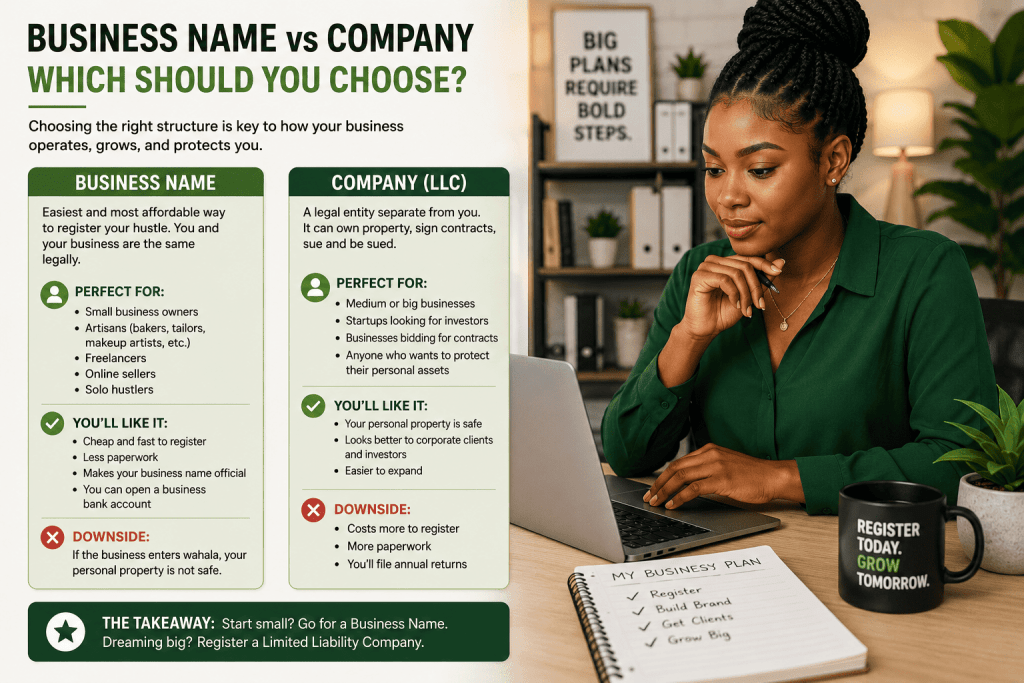
Business Name vs Company: Which Should You Choose?
Now to the famous question:
Should I do a Business Name or a Limited Liability Company?
Let’s make it clear.
What Is a Business Name?
This is the easiest and cheapest way to register a business in Nigeria. It’s like registering your hustle officially, but you and your business are still the same person legally. If the business owes money, you owe money.
Perfect for:
- Small business owners
- Artisans (makeup artists, bakers, hairstylists, tailors)
- Freelancers
- Online sellers
- Solo hustlers
Why You’ll Like It:
- Cheap and fast to register
- Less paperwork
- Makes your business name official
- You can open a business bank account
Downside:
If the business enters wahala, your personal property (like your car or PS5) is not safe.
What Is a Company (Limited Liability Company)?
This one is bigger. It’s like creating a legal person — your company can own land, open accounts, sign contracts, sue people, and be sued without involving your personal property.
Perfect for:
- Medium or big businesses
- Startups looking for investors
- Businesses bidding for contracts
- Anyone who wants to protect their personal assets
Why It’s Cool:
- Your personal property is safe if the business runs into debt
- Looks better to corporate clients and investors
- Makes it easier to expand
Downside:
- Costs more to register
- Requires you to pick directors and shareholders, and state your share capital
- You’ll have to file annual returns
So Which One Should You Pick?
It depends on how far you want to go.
- If you’re starting small and just testing the waters, go for a Business Name registration in Nigeria.
- If you have big dreams or you’re eyeing big contracts, grants, or investors, register a Limited Liability Company (LLC).
Example:
Selling chin chin to your neighbours? Business Name.
Planning to supply chin chin to supermarkets across Nigeria? Company.
What Is Share Capital, and Why It Matters for Your Business
Meet Amaka, the Ambitious Entrepreneur
Amaka started a small fashion business in Lagos, selling Ankara clothes she designed herself. Her clothes were so fresh and on point that she dreamed big — she wanted to open a boutique, hire staff, and maybe even export her designs one day.
But when she went to register her company as a Limited Liability Company (LLC), she was asked about “share capital.” She scratched her head, confused. “What kind of capital? I just want to sell clothes, not open a bank!”
Here’s what she learned — and why you should too.
What Is Share Capital?
Share capital is the amount of money that owners (called shareholders) put into a company when it starts. Think of it as the seed money that shows how much the owners have invested in the business. When you register a Limited Liability Company in Nigeria, CAC requires you to state the share capital — the total value of shares the company will issue.
Why Does Share Capital Matter?
Let’s break it down simply:
- It shows how much money is backing the company — important for banks, investors, and partners.
- It determines ownership in the business — shares equal ownership percentage.
- It protects personal assets — your house and car are safe from company debts.
- It’s a legal requirement — CAC sets a minimum share capital for registration.
- It can help you raise more money by selling shares to investors.
What About Annual Returns?
When you register a company, CAC expects you to file Annual Returns in Nigeria — basically a report about your company’s activities, share capital, shareholders, and financial status every year. Filing Annual Returns is like sending your business’s report card. It keeps the government informed and helps maintain your company’s good standing.
Why Should You Care About Annual Returns?
- It’s the law — failure to file can lead to fines or even your company being struck off the register.
- It helps your business stay credible and trusted.
- It allows you to access loans, grants, or contracts without hitches.
What You Need to Know About Directors, Shareholders, Registered Address, and Other CAC Requirements
Story Time: The Case of Tunde and His “Paper” Business Partners
Tunde was the typical sharp Lagos boy — smart, streetwise, and always spotting opportunities. When he decided to register his logistics business, “SwiftRider Express Ltd,” he thought, “Abeg, let me put my brother Kunle and my girlfriend Bisola as directors, make the CAC form no empty.”
Kunle was in Canada. Bisola didn’t even know the name of the business.
Fast-forward one year later: Tunde wanted a ₦5 million loan to expand his fleet of delivery bikes. The bank asked for a board resolution signed by all directors and shareholders. That’s when wahala started.
Kunle wasn’t reachable. Bisola had become his ex. And Tunde? He was left stranded, regretting his “paper directors.”
The lesson? Understand who a director is, who a shareholder is, and why your company setup matters.
So, Who Is a Director?
A director is someone legally responsible for running the affairs of a company. In Nigeria, every Limited Liability Company must have at least one director (though most people prefer to register with two for flexibility).
What Does a Director Do?
- Makes important business decisions
- Signs legal documents on behalf of the company
- Represents the company in dealings with banks, CAC, and government agencies
- Ensures the company follows laws and regulations
Important: Choose directors you trust — not just anybody to fill a form.
Who Is a Shareholder?
A shareholder (or member) is anyone who owns a part of the company by holding shares. One person can be both a director and a shareholder. That’s right — you can be a one-man army, owning 100 percent of the company while managing it as the director too.
Why Shareholders Matter:
- They own the company and benefit from profits (called dividends).
- They decide big matters, like selling the company or adding new directors.
- They determine shareholding percentages and company control.
If Tunde had known this, he wouldn’t have scattered shares between his ex and an unavailable brother.
What Is a Registered Address?
This is the official location of your business — the address where CAC, banks, and other official parties can send documents to your company.
Does It Have to Be a Fancy Office?
Nope. It can be your house, a shop, a friend’s office, or even a co-working space. But it must be a real, traceable address.
Ready to register your business in Nigeria?
Book A session with us today


Comments are closed